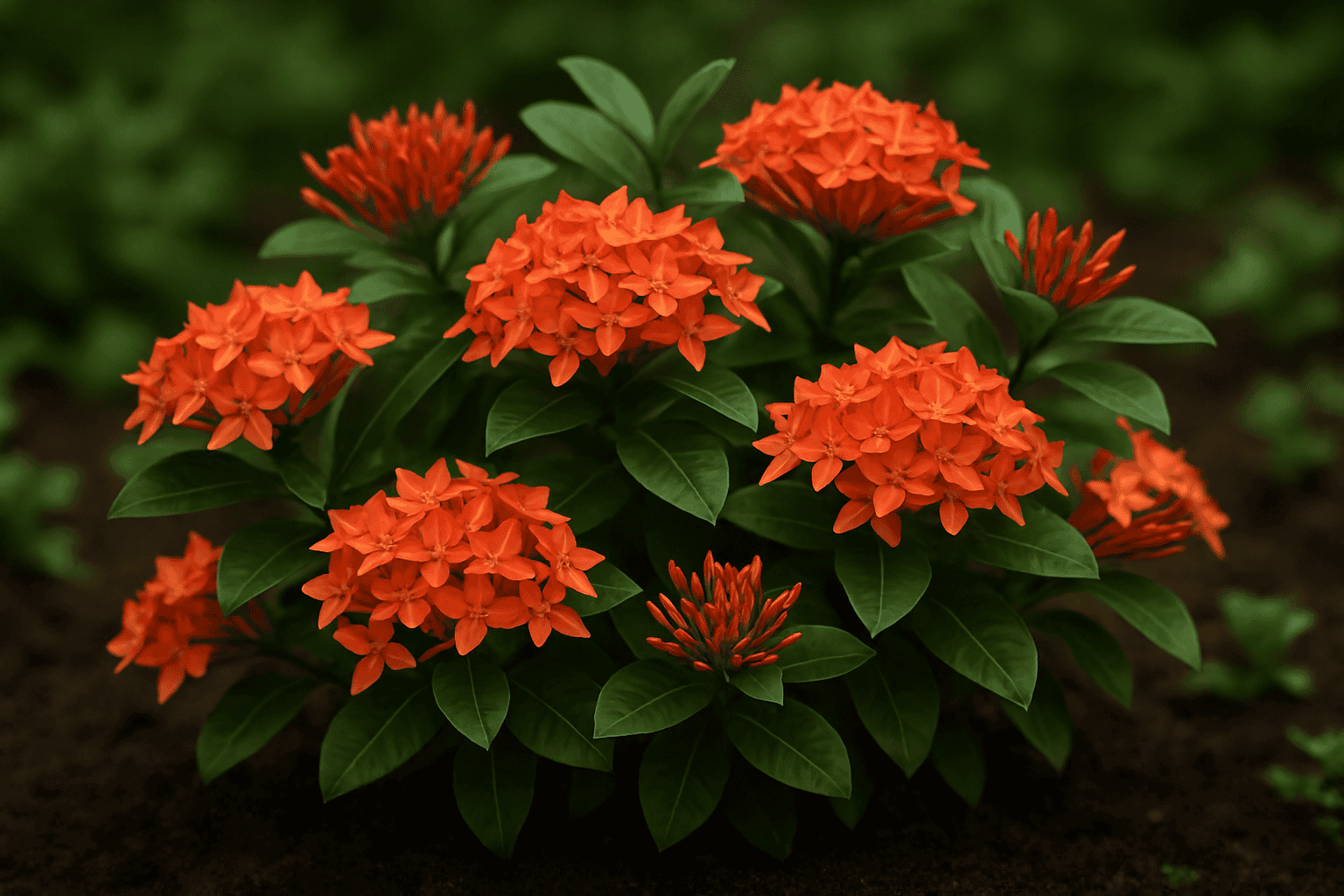
Ixora coccinea is commonly called flame of the woods or jungle geranium. This plant is small tropical flowering shurb with large four petaled flowers.
To maximize growth and flowering, ensure they receive bright, indirect sunlight, well-draining soil, and consistent but moderate watering to prevent root rot.
Scientific Classification
- Kingdom: Plantae
- Clade: Tracheophytes
- Clade: Angiosperms
- Clade: Eudicots
- Clade: Asterids
- Order: Gentianales
- Family: Rubiaceae
- Subfamily: Ixoroideae
- Tribe: Ixoreae
- Genus: Ixora

Prefers
- Light – Bright, direct
- Soil – Well draining
- Soil pH – 5.5-6.5
- Temperature – 65-85 degree Fahrenheit
- Humidity – 50-70%
- Blooming time – Summer
- Flower Colour – Red, Orange, Pink and White
- Native Area – Southeast Asia, Bangladesh
- Toxicity – Human and pets
Ixora plant care with some tips
Adequate amounts of water, light, soil, temperature and fertilizer should be obtained for the Ixora flower plant to grow. The problems and benefits of this plant have also been shared in this article.
In this article, I share some of my own experiences in taking good care of this Ixora flower plant.
If you want to know About Gloxinia plant care.
Light
Ixora plant thrive in bright, direct light with 6-8 hours daily for optimal blooming. They can still bloom in partial shade but the flowers may be less abundant. Place your ixora near a south or west-facing window that receives plenty of sunlight.
Water

Water the plant as needed to keep the soil evenly moist but not muddy. Although the Ixora plant prefers moist soil, it may rot in excessively soggy soil. It thrive in consistently moist soil but avoid overwatering which can lead to root rot. During the winter months, reduce watering frequency.
Soil
Ixora plant prefers well draining, slightly acidic soil with a pH level between 5.5-6.5. It has organic matter like compost, peat moss or well-rotted manure helps improve drainage and nutrient content.
Temperature & Humidity
A warm, moist temperature is ideally between 65-85 degree Fahrenheit.They are sensitive to cold and should be protected from temperatures below 40°F. However, they are sensitive to frost which can severely impact their growth and overall health.
It thrive in humid environment with optimal humidity level between 50-70%. Optimal humidity supports healthy growth and abundant flowering. Maintaining this humidity range is crucial for their growth and prevents issues like leaf curling, dropping and increased susceptibility to pests.
Fertiliser
During the growing season feed your plant with slow release fertiliser. Proper nutrition will help boost the chances of your plant flowering.The ideal NPK ratio for Ixora is either 3-1-2 or 10-10-10. These ratios provide a balanced supply of nutrients tailored to the plant’s needs. Apply organic liquid fertilizers two weeks after planting
How to Propagation and Care of your Ixora Plant

Ixora plant propagate by stem cuttings with air layering and seeds also being viable options. The best time for propagation is late spring to early summer when the plant is actively growing.
Use rooting hormone can be beneficial for faster and more successful root development.
- Cut 4- to 6-inch piece of a branch and dip the ends in rooting hormone.
- Water lightly until roots form in four to six weeks.
- Place in well draining soil mix and maintain high humidity.
How to Pruning and Care of your Ixora Plant
Pruning is the essential part of its care that keeps your Ixora healthy and encourage lush growth.
Deadheading spent flowers and removing crowded or crossing branches also promotes healthy growth and better air circulation. Trim stems to maintain the desired shape and size of the plant.
Flowers bloom on new growth so pruning is a great way to increase the blooms on your plant.
Types of Ixora Plant
- Ixora coccinea : Another variety of Ixora plant is woody, evergreen, flowering shrub native of southeast Asia has become popular in Florida. It is an Ayurvedic medicinal plant used as natural remedy for diarrhea, painful periods, vaginal white discharge.
- Ixora javanica : It is an evergreen shrub or tree and native to Southeast Asia. This plant has vibrant, dense clusters of orange-red to red flowers.
- Ixora finlaysoniana :Ixora finlaysoniana is a species of shrub in the family Rubiaceae. Across the tropics it is also commonly cultivated as an ornamental tree or shrub.
- Ixora chinensis : Ixora Chinensis is characterised by its bright and colourful flowers of red, pink, orange and yellow.It is a shrub and grows primarily in the wet tropical biome. It is used as a medicine.
- Ixora singaporensis : Ixora Singaporensis is commonly known as the Singapore Ixora or Jungle Flame. It is a tropical evergreen shrub native to Singapore and Malaysia.
- Ixora Rosea : Another variety of Ixora Plant is Ixora Rosea, it is commonly known as Chinese Ixora.They prefer to be grown in full sun to partial shade and need regular watering to thrive. These plants can grow to be 3-5 feet tall and wide.
Ixora Plant Care: The Essential Guide to Repotting for Longevity
Repotting is very important to extend the lifespan of Ixora plants and keep them healthy.When the plant grows out of its current pot or the soil loses its nutrients, a healthy root develops.
1.Choose a pot that is only slightly larger than the previous one and use a well-draining potting mix, such as a blend of garden soil, perlite and peat moss.
2. Proper drainage holes is a good choice for repotting with the pot should be only slightly larger than the previous one to avoid over-potting.
3. It is best done in the spring or early summer, especially if they are root-bound or showing signs of stress, like yellowing leaves or roots escaping drainage holes.
Common problem of Ixora Plant

- Leaves Dropping : Extreme Temperature or cold draft the plant’s location in your home can cause it to drop leaves or root rot.
- Nutrient deficiency : Alkaline soil can cause dark spots or yellowing the leaves and Reddish-purple spots on older leaves can indicate a deficiency in these macronutrients.
- Pest Infection : Aphids, Mealybug can manifest as black spots on leaves. Removing affected leaves and applying a fungicide can help.
Benefits of Ixora Plant
- Ixora plant can be used for hypertension and also used to treat abscesses, wounds, rheumatism and bruises.
- A beneficial point is to attract pollutants.The vibrant flowers attract pollinators like bees and butterflies and supporting local ecosystems. It has vibrant and long-lasting flowers, adding a burst of color to any space.
- The most common benefit is air purifier by removing pollutants and toxic gases. It can help increase humidity levels which can be beneficial for indoor use especially in dry climates.
Ixora Plant Faq
1. Where is the best place to plant Ixora?
Ans. This is very adaptable plant and some of the best places to plant Ixora such as porches, patios and front of the border.
2. Can Ixora tolerate the cold?
Ans. This plant cannot tolerate the cold temperature especially when the temperatures dip down to 20 degree Fahrenheit.