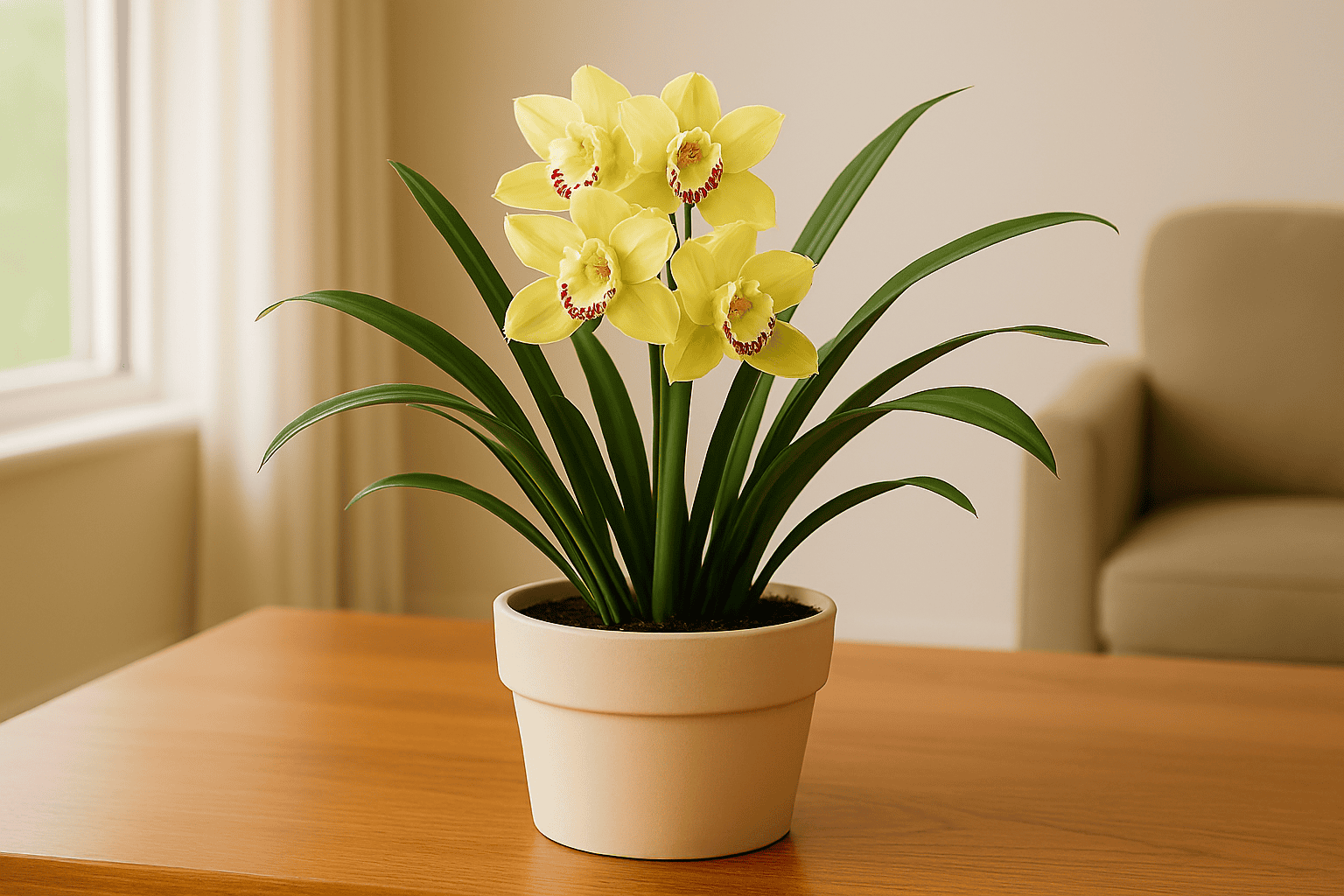
Cymbidium orchid plant is one of the many types of orchids, it is commonly known as boat orchid. It has stunning sprays of long lasting flowers. This plant is more cold tolerant flowering orchid plant than many other species of orchid. Its feature large blooms in winter on flower spikes with long, thin leaves.
Scientific classification
- Kingdom: Plantae
- Clade: Tracheophytes
- Clade: Angiosperms
- Clade: Monocots
- Order: Asparagales
- Family:Orchidaceae
- Subfamily: Epidendroideae
- Tribe: Cymbidieae
- Subtribe: Cymbidiinae
- Genus: Cymbidium


Prefers
- Light – Bright, indirect light
- Soil – Well draining
- Soil pH – 5.5 to 6.5
- Temperature – 50-80° F
- Humidity – 40% to 60%
- Blooming time – Late autumn to Spring
- Flower colour – Orange, green and pink
- Native area – Asia and the Philippines
- Toxicity – Non toxic
Cymbidium orchid plant care with some tips
Adequate amounts of water, light, soil, temperature and fertiliser should be obtained for the plant to grow. The problems and benefits of the plant have also been shared in this article. This article will help you with all the essentials you need to grow your plant.
If you want to know Cattleya Orchid care.
Light
Cymbidium orchid like a lot of light and several hours of direct sun early in the day is preferable. It will have bright, lime-green leaves and an orchid getting too much light will have leaves turning yellow. When this plant is not getting enough light will have darker green leaves, and they will not produce flowers.
Water

This plant needs watering every day in the hot summer month. In the spring and summer, consistently water these orchids. During the winter bloom, reduce watering. Tap water can cause damage, such as leaf-tip dieback, in which the leaf turn black and die. So make sure to flush water through the potting mixture.
Soil
Cymbidium orchid prefer acidic, well draining soil with loamy, humus type. A combination of fir bark, perlite, peat moss and other loose organic material will ensure good drainage. If planting in containers, use a high-quality potting mix. Make sure containers have adequate drainage holes.
Temperature & humidity
This plant grow best in temperature between 50-80 degree Fahrenheit. They can tolerate temperatures as low as near freezing. Cymbidium orchids are cooler temperature orchids. They are cold tolerant to about 40°F.
It need humidity level between 40-80% depending on the season. Winter season humidity level is 40-50% and summer has 70-80% with ideal during active growth. Use humidifier to increase the humidity level.
Fertiliser
Fertilise your plant in proper time to help Cymbidium flowers. Feed orchid fertiliser bimonthly. Avoid high nitrogen fertiliser, it can cause rapid foliage growth at the time of orchid’s blooms. It should be fertilise every 1-2 weeks during the growing season and then 3-4 times for low growth. A 10-10-10 fertilizer diluted to ½ strength or a 20-20-20 reduced to ¼ strength is both good options if you prefer an all-purpose fertilizer.
Propagation of Cymbidium orchid plant care


Propagation is the process when you want to grow up another plant. The best time to take your plant cutting for propagation is growing season when the plant actively grow healthy. The easiest way to propagate by division during repotting in the Spring.
Cymbidium Orchids are very susceptible to fungus and bacteria, so sterile tools are important. Divisions should have three bulbs each. Plant the rhizomes in a pot on top of a bed of damp orchid compost. Don’t water the plant for three weeks. Make sure, beginning water when you notice new growth your plant.
Pruning of Cymbidium orchid plant care
Prune when the plant is dormant and growth has paused. Pruning is the essential part of its care that keeps your plant healthy and encourage growth.Trimming your plant for new growth to produce more new branches. Make sure to trim just above a set of leaves and regular pruning will also increase the chances of the plant producing its stunning, fragrant flowers.
Use a sharp, sterilised knife to make clean cut the pruning area. Cymbidium orchid pruning involves cutting away dead, dying, or discoloured leaves and stems, and removing dead roots.
Types of Cymbidium orchid plant
- Cymbidium kanran : This variety is a species of orchid and also known as cold growing cymbidium. It
is classified as a second-level protected plant in China and is also listed in the World Genetic Conservation Plant Registry. - Cymbidium ensifolium :Cymbidium ensifolium is also known as golden thread orchid. It has a number of different cultivars of interest to orchid collectors.
- Cymbidium aloifolium : This variety is also known as aloe-leafed cymbidium. Maintain humidity level of 60% – 80%. Regular watering in plants helps maintain the humidity and encourage growth.
- Cymbidium tracyanum:Cymbidium tracyanum is one of the largest plants with the largest flowers.This is a large sized, cold to cool growing plant that can withstand near-freezing temperatures.
- Cymbidium goeringii : This variety is also known as noble orchid. It
is an adaptogenic herb and botanical tonic derived . It is known for aiding the body in increasing energy levels and adapting to stress. - Cymbidium dayanum :Cymbidium dayanum is also known as the phoenix orchid. Water plants thoroughly when compost is almost dry, allow to drain and use orchid fertiliser regularly during growing season.
Repotting of Cymbidium orchid plant care
After flowering the plants should be repotted. The healthy new plants were repotted into the soaked potting medium. Repotting is important if you want to grow more than one of your favorite plants. Carefully remove the roots and place the plant in the new pot. Avoid repotting during slow growing season or immediately after a stressful event, such as a pest infestation.
Select a container that’s about 10 cm wider than the previous pot, and has good drainage. Avoid using a much larger pot as the compost will stay wet for longer, which can cause root rot.
Common problem of Cymbidium plant
- Cymbidium orchids can be damaged by low temperatures, even if they are not covered in frost. It can be affected by leaf diseases that cause yellowing, spotting, or discoloration on the leaves.
- The most common problem is pest effects such as Spider mite and Aphids, it appears on the leaves and plant surfaces which will yellow and may darken and can cause the leaf to drop prematurely.
- Insufficient water is the main culprit, black leaves signify a cymbidium dying. Too much light will cause blanching of the leaves, then browning.
Benefits of Cymbidium plant

- Cymbidium orchid are popular for its sweet fragrance and graceful flowers. They come in a variety of colors, including white, pink, orange, and yellow.
- This plant used to treat a variety of conditions, including dizziness, eye problems, chronic disease weakness, burns, and wounds.
- The cymbidium is sold both as individual blossoms inserted into water tubes and as full spikes of 8 to 15 blossoms per spike. Individual blossoms are used for wedding and corsage work.
Cymbidium plant Faq
1. What is the lifespan of Cymbidium orchid?
Ans. Cymbidiums are one of the longest living species of orchids. Expect cymbidium orchids to live up to15 to 20 years as an indoor plant with proper care.
2. How long do cymbidium flowers last?
Ans. You can expect a potted cymbidium to bloom for one to three months. A cut cymbidium can last up to 6 weeks in a vase of fresh water.