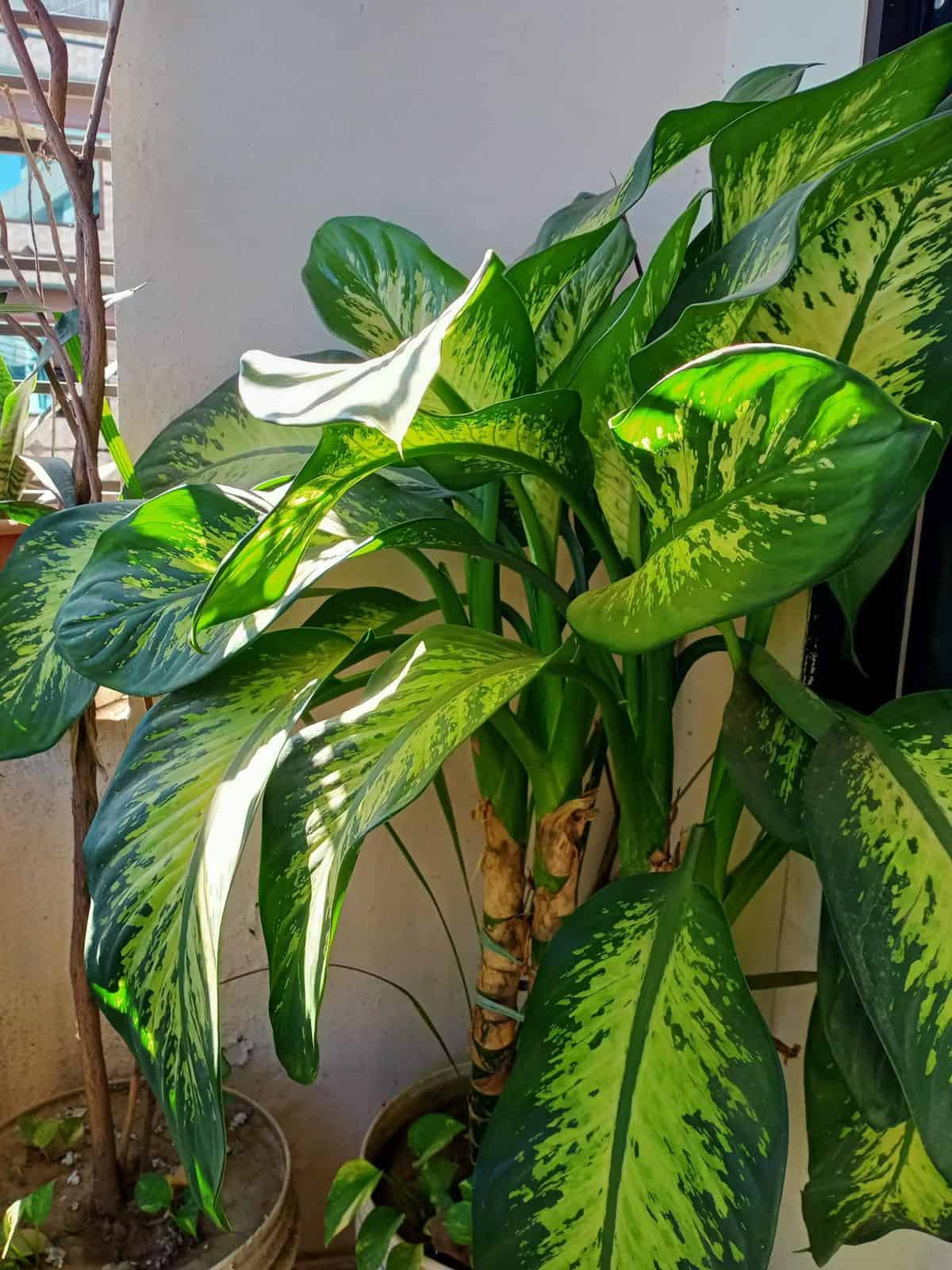
As far as we know, this plant grows well in bright light, but it can be damaged by direct light. So let’s learn something more interesting about care of this dumb cane plant.
I bought this plant in my house about seven years ago. Since then, my father and I have been taking care of it. My father bought this plant from the local nursery and it was very small, but now it has grown into a big one.

This is not exactly what I brought seven years ago. But I just give you a idea of my dumb cane plant.

Now my plant look like. This Dumb Cane Plant is now in my Fav list.
Table of Content
Here some seceret about your Dumb Cane Plant see here

Scientific Classification of Dumb Cane Plant
- Kingdom: Plantae
- Clade: Tracheophytes
- Clade: Angiosperms
- Clade: Monocots
- Order: Alismatales
- Family: Araceae
- Subfamily: Aroideae
- Tribe: Dieffenbachieae
- Genus: Dieffenbachia


Dumb Cane Plant Prefers
- Light– Bright,indirect light
- Water– Twice a Week
- Temperature– 60-80 degree Fahrenheit
- Humidity– 40-50%
- Soil– Well draining
- Soil pH– 5.5-6.5
- Native area– Mexico and Argentina
- Toxicity– Human and pets
How to grow and care of Dumb Cane Plant
Here, I will explain you about how to grow your plants with important tips.
Light
Dumb cane plant is a tropical plant that grows well indoors in lots of indirect light. It can tolerate low light, but its growth will slow dramatically. Given more light, it will quickly begin to grow again. It prefers diffused sunlight or partial shade, but will tolerate full shade, which is why it is well-suited as an indoor plant. Avoid direct sunlight which can burn the leaves.
Water


This Dumb cane plant watered twice per week during warmer months. Water it less often during colder months. For smaller plants, once per week is more than enough. As long as the soil stays consistently moist but not too wet your dumb cane will thrive. Dieffenbachia grows best with soil that’s not overly moist. Hold off on watering the plant until the top 2 inches of soil are dry, then water thoroughly at the base of the plant. Droopy leaves are usually a sign that the plant needs to be watered.
Soil
The Dumb cane plant prefers well-draining soil. Use 2 part peat moss and 1 part perlite. Choose the pot diameter according to the size of the plant. Pot or repot, during springtime. A soil mix of peat moss, perlite, and coarse sand or barkis ideal for this variety. This type of soil mix allows for adequate water drainage and aeration, preventing waterlogging and root rot. Choose a pot for your dieffenbachia that’s no larger than 2 times the size of the original nursery pot – make sure it has drainage holes or use a black plastic pot that sits snugly inside a cover-pot or cache pot
Temperature & humidity
Taking care of Dumb cane plant is easy if season changes. It adjusts well to different temperature seasons, but it is suggested to avoid temperatures below 23 degree fahrenhite in winter and over 95 degree fahrenhite in summer. Dieffenbachia prefer medium sunlight, moderately dry soil and average home temperatures of 62–80 °F. Most require water about twice a week.
Dieffenbachia respond well to hot temperatures and dry climates. Dieffenbachia enjoys humid environments with an optimal humidity range between 60-70%. Although it can handle humidity levels as low as 40%, it may start to show signs of stress, like brown leaf edges or wilting. A relatively humid atmosphere results in vigorous growth, as the large leaves can dry out in a warm room.
Fertilizer
Fertilizing dumb cane plant causes it to grow faster and produce more leaves. You can feed plants monthly with a diluted houseplant fertilizer that you mix with water, such as Espoma’s indoor organic plant food or Jack’s Classic balanced plant food where the three numbers read the same, like 20-20-20.For dieffenbachia, opt for high nitrogen fertilizers, supporting lush foliar growth. Quarterly applications are ideal, reducing to bi-annually in winter. Use dilute solutions to prevent root burn; excess is harmful. During active growth, more frequent feeding every six weeks bolsters vigor.


How to propagate your plant
Dumb cane plant can be propagate by two ways- stem cuttings and air layering. To propagate from the cane, cut a piece of the cane that has at least one bud on it with a properly sterilized razor. Place each cut piece of cane horizontally in its own pot.
For faster rooting, use a combination of moistened potting mix and peat moss. Plants with prominent leaf veins can be propagated from leaf-vein cuttings in two ways: take a leaf and cut it into sections, each section with a vein. The bottom portion of the vein can then be pressed into the propagation medium with the leaf portion sticking up to root just like a leaf cutting.
Layer cutting is a very difficult process to propagate and is the correct method for older plants.
Important notes
Pruning of Dumb Cane Plant
To create a fuller, bushier Dieffenbachia, aggressively prune your plant. Pruning the plant also keeps it from getting too ‘top heavy’ due to leaf growth. It’s normal for a dieffenbachia to become tall and leggy over time, losing its lower leaves.
You can simply cut the plant down to its desired height – it should resprout from the point where it was cut. If the growth of your dieffenbachia has slowed or stopped it is likely not receiving enough light.Lower leaves on plant stems (also called canes) turn brown as they age. Gently tug these free or snip to remove them.
As dumb cane plants mature, stems may become too tall and bare looking, resembling tree trunks. Rejuvenate plants by cutting stems back to 6 inches tall.To encourage bushier growth and manage the size of the canes, remove unhealthy, yellow leaves and prune stems at the top of the plant.
Common problem of Dumb cane plant
1. Lower leaves of Dieffenbachia turn yellow and spots appear. Rotten spots feel mushy, soft, or watery. Infected areas have a rotten, fishy smell.
2. The roots get too soggy, can’t breathe, and before you know it, you’ve got root rot. Leaves droop and fall over as if they’ve given up on life.
3. Dumb canes come from the jungle, so they are used to growing behind big trees and do not need a lot of light exposure. But if they receive less light than needed or if their light conditions change drastically, dumb cane leaves turning yellow as well as wilting is a common symptom.


Benefits of Dumb Cane Plant
- Gardeners prize this houseplant for its variegated leaves, not flowers, and also for its ability to purify indoor air.
- Dieffenbachia plants are considered to be lucky for a home. They bring positive energy and have been known to attract good luck in the form of money and other forms of abundance.
- Dumb cane is native to tropical America and the West Indies. Cultivated varieties typically have large simple leaves that are often variegated with other greens.