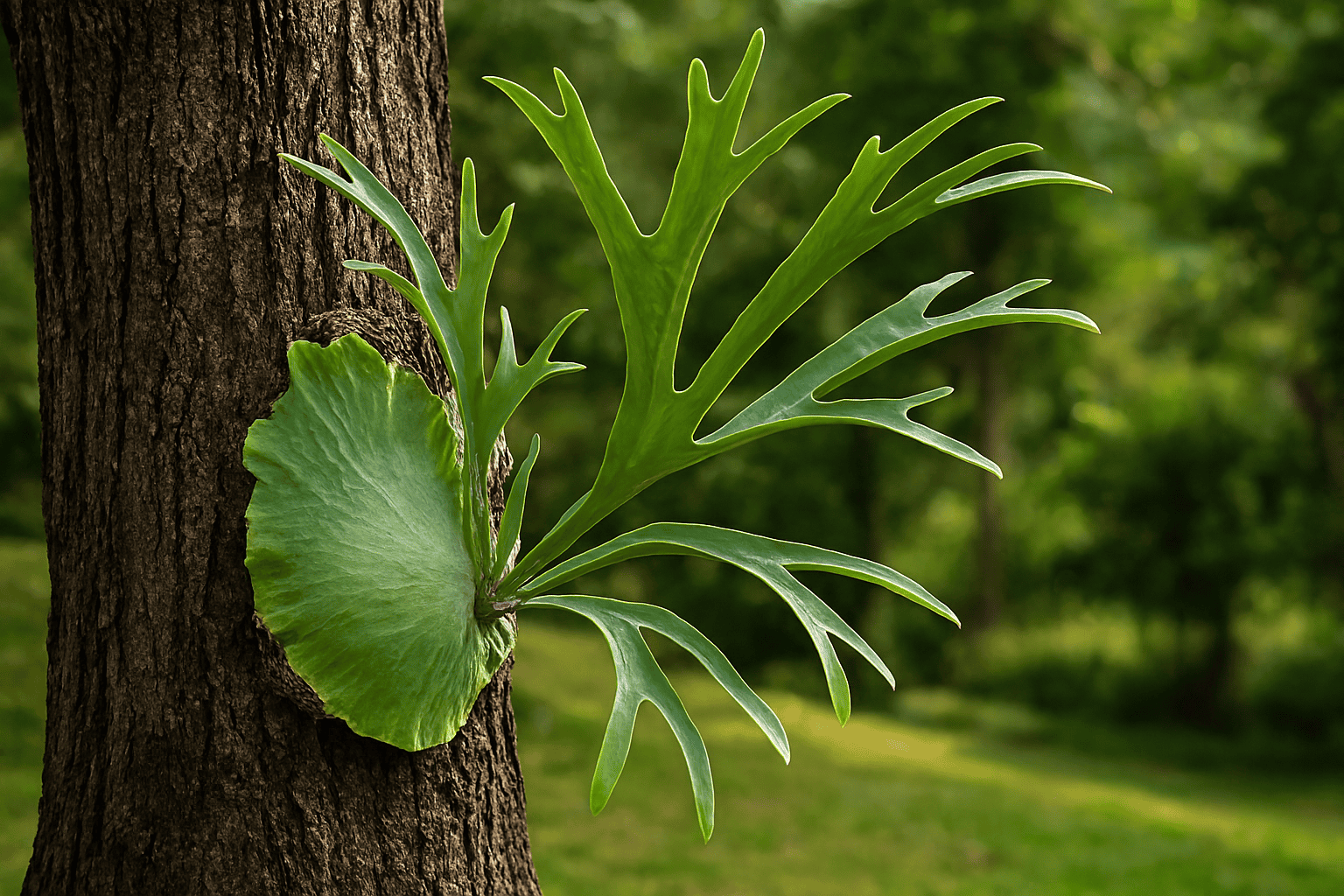
To be care healthy growth Staghorn fern plant, it requires bright, indirect light, well-draining soil, regular watering, proper temperature and humidity.
Introduction
Staghorn fern is an epiphytic plant that’s know for its shape. It has small flat leaves that cover and protect the root ball structure. This plant is grow in a humid, draught free environment such as bathroom. Staghorn Fern is a fern non-flowering perennial with two types of leaves like heart-shaped and antler-shaped leaves.
Scientific classification
- Kingdom: Plantae
- Clade: Tracheophytes
- Division: Polypodiophyta
- Class: Polypodiopsida
- Order: Polypodiales
- Suborder: Polypodiineae
- Family: Polypodiaceae
- Genus: Platycerium

Prefers
- Light – Bright, indirect light
- Soil – Well draining
- Soil pH – 6.0 and 7.0
- Temperature – 50-75 degree Fahrenheit
- Humidity – 60–80%
- Blooming time – Spring and Summer
- Flower colour – Blue green
- Native area – Africa, Australia
- Toxicity – Human and pets
Staghorn fern plant care with some tips
Adequate amounts of water, light, soil, temperature and fertiliser should be obtained for the plant to grow. The problems and benefits of the plant have also been shared in this article. This article will help you with all the essentials you need to grow your plant.
If you want to know Asparagus fern plant care.
Light
Staghorn fern prefers bright, indirect light with some filtered light. This plant can tolerate some morning sun but direct light can cause scorch the leaves. The ideal place is an east facing window. It can tolerate more light if given enough water, warmth and humidity.
Water

Water is the essential component of Staghorn grow success. Get water when the soil is dry and it more frequently in the Summer, about once every 2-3 weeks. You can adjust the watering schedule based on the amount of light, humidity. Water your Staghorn Fern so the top inch of soil is kept moist.
Soil
It can grow best in well draining soil and prefers mix potting soil include peat moss or coir, fir bark, perlite, and charcoal. Sphagnum moss is a good choice for staghorn fern plant. Applying a mixture of orchid bark and cactus soil will work best.These flowers prefer a neutral to alkaline soil pH level. If you can provide prolonged exposure will cause the root rot.
Temperature & humidity
This plant thrives in 50-75 degree Fahrenheit with moderate to high humidity. Daytime temperatures around 80 degree Fahrenheit or more and night time temperature is 60 degree Fahrenheit, it cannot tolerate temperature below 55 degree Fahrenheit.
The ideal humidity level is between 60-75%. If you can increase the humidity level then use humidifier or pebble tray filled with water. To be care growing medium must also be very well draining.
Fertiliser
Feed your Staghorn plant, use a balance 20-20-20 fertiliser. To make your plants grow faster, apply fertilisers when the plant starts flowering. It may cause plants to produce excessive foliage at the expense of blooms.This helps the plant get enough nutrients to continue to grow. Fertilizing frequency can slow to every other month during the fall and winter. Liquid fertilizers are easy to apply and can be diluted to prevent root burn.
Propagation of Staghorn fern plant care
Staghorn fern plant propagate by division, it is slow process. It can be grown from spores, it takes a very long time. Propagation is the process when you want to grow up another plant. The best time to take your plant cutting for propagation is growing season when the plant actively grow healthy. Plant the separate section individually in pots filled with peat and compost. To make sure new division are kept in warm and moist until they are growing independently.
Types of Staghorn fern plant
- Platycerium andinum : This plant is also known as Andean Staghorn Fern, it absorb water through their fronds as well as the roots so be sure to soak the basal fronds and the medium.
- Platycerium alcicorne : It is native to Madagascar and cultivated as an ornamental plant for garden. This plant is very sensitive to dry soil, so choose a potting soil that retains moisture.
- Platycerium superbum : Another variety of Staghorn plant is native to Australia. It has weirdly wonderful, unique and antler shaped leaves.
- Platycerium coronarium : This plant thrives best in a humid environment with bright, indirect light.
- Platycerium grande : This plant is also known as giant staghorn fern. It likes high humidity. These tropical plants need good air circulation, bright indirect light, warm temperatures, moderate humidity and consistent moisture.
Pruning of Staghorn fern plant care

Pruning is the essential part of its care that keeps your plant healthy and encourage growth.Make sure to trim just above a set of leaves and regular pruning will also increase the chances of the plant producing its stunning, fragrant flowers.Trimming your plant for new growth to produce more new branches.
There is no need to prune your plant, simply allow the foliage to die back naturally. Trim the foliage and dead leaves the spent flowers of Snowdrop. To get them nutrients to the bulb through the foliage until the leaves begin to fade.
Repotting of Staghorn fern plant care
Staghorn plant should be repotted when they are slightly crowded and usually once every few years.This process can stress the plant so only do it when necessary. The best time to repot your plant in early spring. After the flowers bloom then the energy shifts to root development and making it the ideal time to repot. Choose a new pot that’s 2 inches wider than old pot. Use well draining potting mix with proper care.
Common problem of Staghorn fern

- The common problem is pest attacks like mealybugs, scale insects, spider-mites. It can cause leaves discolour and drooping leaves.
- Another problem is fungal infection like powdery mildew and root rot. Powdery mildew cause white spot on leaves.
- Overwatering and under watering can cause the leaves turing yellow and black spot can caused by too much humidity.
Benefits of Staghorn fern
- The most common benefit is air purification, its absorb pollutants like formaldehyde from the air and convert them into less harmful substances.
- It can use for decorative purpose like add an exotic vibe to any space, especially when mounted.
- Staghorn fern is an epiphytic plant with diverse medicinal uses, such as anti-ulcer remedy, treating oedema, coughs and hypertension.
Staghorn plant faq
1. Can staghorn ferns be grown outside?
Ans. Yes, staghorn ferns can be grown outside in enough shade.
2. What is special about a staghorn fern?
Ans. It has small, flat leaves and prolonged antler like fronds which make them appear.