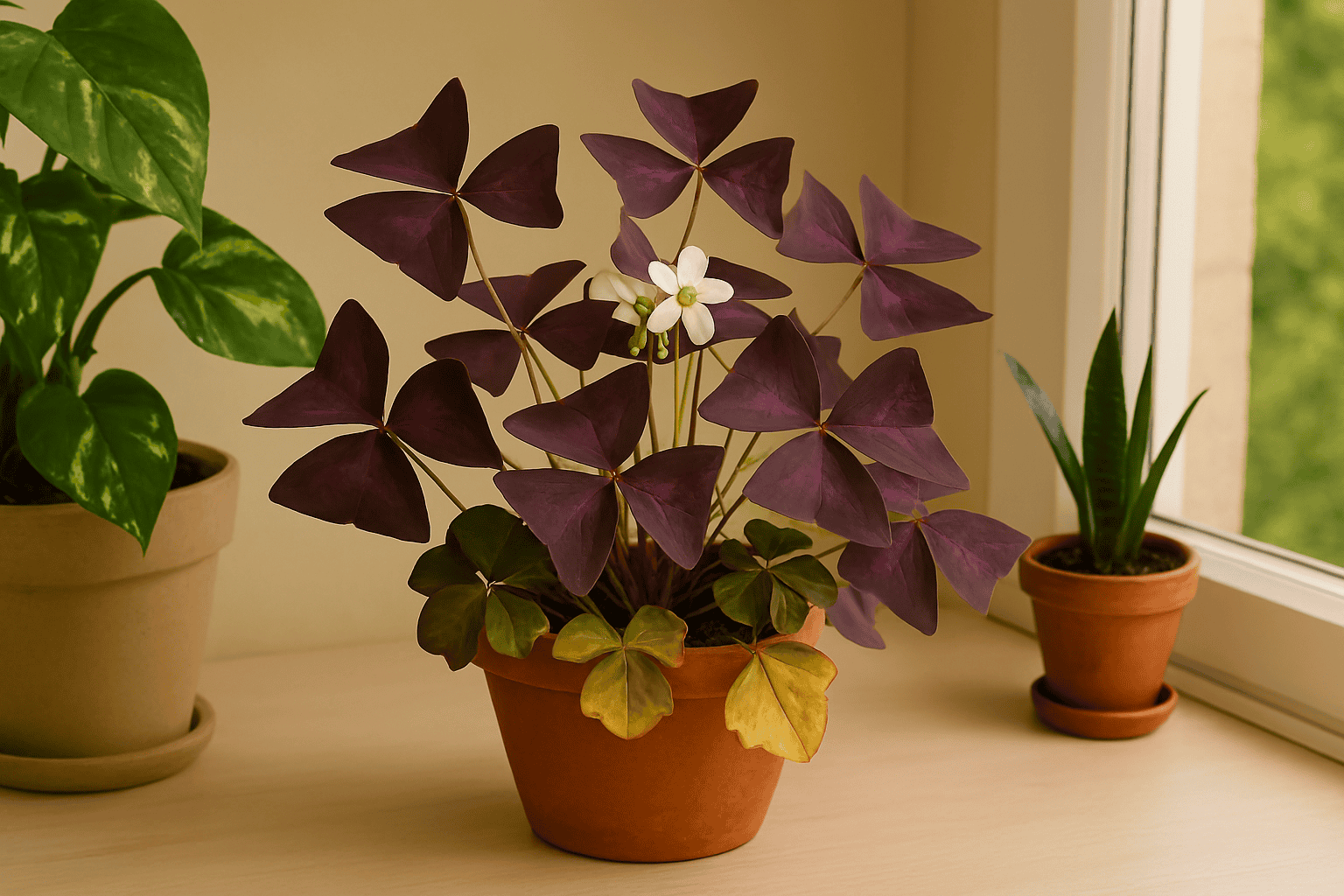
Purple Shamrock is commonly known as false shamrock with deep purple and black foliage. It has three purple heart shaped leaves with green indoor plant. This plant is a low growing foliage, an attractive indoor plant with rich, vibrant and purple leaves. Its beautiful foliage produces small, trumpet-shaped flowers in shades ranging from pink to white, complementing its vibrant leaves.
However, if you can provide the appropriate growing conditions, your plant may survive several years. I have shared the steps taken to grow this plant in this article which will guide you.
Scientific classification of Purple Shamrock plant care
- Kingdom: Plantae
- Clade: Tracheophytes
- Clade: Angiosperms
- Clade: Eudicots
- Clade: Rosids
- Order: Oxalidales
- Family: Oxalidaceae
- Family: Oxalidaceae
- Species: O. triangularis

Prefers of Purple Shamrock plant care
- Light – Bright, indirect light
- Soil – loamy, sandy soil
- Soil pH – 6.0 to 6.5
- Temperature – 60 and 75 degrees Fahrenheit
- Humidity – 40% to 60%
- Bloom time – Spring and winter
- Flower colour – Purple
- Native area – South Africa
- Toxicity – Human and pests
Purple shamrock plant with some care tips
This article will help you with all the essentials you need to grow your plant. Adequate amounts of water, light, and soil should be obtained for the plant to grow. The problems and benefits of the plant have also been shared in this article.
If you want to know about balcony indoor plant.
Light
Purple shamrock plant grow in partial shade that’s means it’s prefers two to four hours of direct light. If your plant getting too low light then it is growing leggy. Place this plant in too much then the leaves to burn. The best place is near a south facing window so that it’s not getting direct light.
Water
Get water when the soil is dry and this plant cannot tolerate soggy soil. During the growing season, water when the top inches of soil is dried out and the plant is dormant in Summer. As a precaution, expect to water once every 2 weeks as excess water can cause root rot.
Soil

Purple shamrock plant can grow variety soil with good drainage. All of the variety loamy ,well draining, sandy soil is best.A mixture of equal parts peat moss, perlite, and potting soilworks well. This combination promotes good drainage while retaining adequate moisture for the plant.
Temperature & humidity
This plant prefers 60 and 75 degrees Fahrenheit which makes them suitable for growing room temperature.These temperatures should be between 50-65 degrees F at night, and no greater than 75 degrees F during the day. Moderate humidity level is ideal for purple shamrock plant.
The humidity level is 40-50% where they can thrive without the stress of too much or too little moisture. Humidity above 50% when in active growth will support a healthy plant with attractive leaves. In dry indoor environments, use a humidifier to keep up the humidity levels.
Fertiliser
Using fertilisers is the process to grow your plant easily. During the growing season use liquid or slow fertiliser. Nitrogen, phosphorus, and potassium are Purple shamrock plant’s growth. Nitrogen is crucial for lush foliage, while phosphorus promotes strong root development and potassium fortifies against diseases. Mixing some compost into the soil also can help to promote healthy growth.
Propagation of Purple shamrock plant
Propagation is a method by which you can make many plants of your choice. The best way to propagate your Purple shamrock plant can be propagated by division like stem cuttings during the growing season. Division is a effective way to get new plants, and it prevents the mature plant from becoming overcrowded.
Generally, the root ball divide in half sections and use sterilised scissors. Replant each new section in a container. Keep it in near a window with proper care. Put the cutting in a moderate place with bright, indirect light until the plant is well-rooted and growing. If you see the new growth then water thoroughly.
Pruning of purple shamrock plant

Pruning is the essential part of its care that keeps your plant healthy and encourage lush growth. Trimming your plant for new growth to produce more new branches. Make sure to trim just above a set of leaves and regular pruning will also increase the chances of the plant producing its stunning, fragrant flowers.
You should cut the flowers at the end of the growing season. Also remove the damaged leaves. Trim the brown foliage to about an inch from the plant’s base. You can also pinch off leggy stems to encourage bushier growth.
Types of purple shamrock plant
- Oxalis adenophylla: This species has silvery green leaves and pink flowers with deep purple centers.
- Oxalis tetraphylla: This plant has four split leaves. The leaves are bright green with maroon center.
- Oxalis acetosella: This plant has bright green, heart-shaped leaves.
- Oxalis lasiandra: This species is referred to as the Mexican shamrock. It bears bright pink flowers to crimson flowers.
Repotting of Purple shamrock plant
Use a quality all-purpose potting mix that drains well.Care should be taken when repotting that the soil of the plant is completely dry.Keep your plant with proper care and wait a week before watering after repotting because a risk of root rot. Carefully remove the excess amount of soil from the root before placing this plant in a new container.
Common problem of purple shamrock plant
- Overwatering is a common problem with Purple Shamrocks, leading to root rot and yellow leaves.
- Aphids, scale, and spider mites are the usual suspects, each leaving their mark with damaged or discolored foliage that creates white spots on the foliage.
- Root rot is a fungal disease that affects the roots of the plant. It is caused by overwatering and can cause the leaves to turn yellow.
Benefits of purple shamrock plant

- Traditionally used as a domestic herbal remedy, this plant boasts antispasmodic and astringent qualities.
- This plant symbolise faith, hope, and love, with the elusive four-leaf clover adding luck to the mix. The leaves have anti-viral, anti-inflammatory, anti-cancer properties and reduce cholesterol, boost cognitive function and prevent colds and flus.
- It contain vitamins and minerals like vitamin C, K and various B vitamins, as well as fiber. These nutrients play important roles in supporting the immune system, bone health, and energy metabolism.