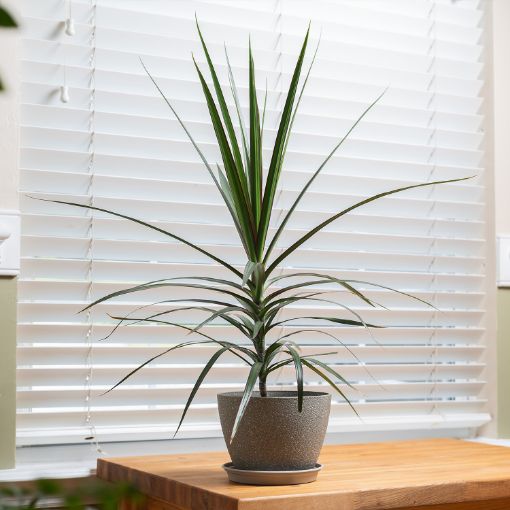
The Dragon tree, native to Portugal, is a spiky, drought-tolerant plant. It prefers indirect sunlight, loamy soil, and temperatures of 65-80°F. It requires minimal watering and should be kept away from pets. The plant’s care involves fertilizing, pruning, and propagating. It is known for reducing indoor pollution and is considered auspicious in Feng Shui.

Dragon tree is native to Portugal, the eye- catching spiky tree and also drought tolerant. Keep this plant away from pets because it’s toxic for pets. I have shared with you how to grow this dragon plant slow growing but easy to care.
Scientific classification of Dragon Plant
- Kingdom: Plantae
- Clade: Tracheophytes
- Clade: Angiosperms
- Clade: Monocots
- Order: Asparagales
- Family: Asparagaceae
- Subfamily: Nolinoideae
- Genus: Dracaena
- Species: D.draco


Dragon Plant Prefers
- Light – Indirect Sunlight
- Soil – Loamy soil
- Soil pH – 6.0-6.5
- Temperature – 65°F and 80°F
- Humidity – 40-50%
- Bloom time – Spring
- Flower colour – White or Green
- Native area – Cape Verde, Morocco and Portugal
- Toxicity – Human and pets
Dragon Plant Care
Here, I will share my own experience how to grow your Dragon tree with some valuable tips.
Light
Dragon trees do best in bright, indirect sunlight. Avoid placing your tree in direct sunlight, as this can scorch the leaves. Avoid placing it in spaces with low light or spaces without natural sunlight.
Aim to place the tree in a space where it can absorb 10 hours of indirect sunlight. Keep it away from areas that receive harsh, direct sunlight.Choose a location that receives full sun to partial shade. While Dragon Trees can tolerate various light conditions, they thrive and develop the best color in a spot with ample sunlight.
Water


Avoid overwatering dragon trees. Wait until the compost is dry before watering it should be about half dry. Once a week or until the top two inches of soil are dried out. Using a half strength liquid fertiliser every two weeks in the summer can also help to achieve maximum growth.
Reduce watering and stop feeding during the colder autumn and winter.We suggest watering an indoor Dracaena marginata every 6-10 days as needed during periods of warm weather and fast growth.
Dragon Tree will require less frequent watering during slower periods of growth such as over winter.
Soil
Dragon tree is use a loose, well-drained potting mix when growing your plants as a potted plant loamy soil amended with peat moss is ideal.
It’s heavy, holds on to moisture and takes some time to dry out. A free-draining potting compost is better suited to most indoor plants, including Dracaena, provided you keep an eye on it and water when dry.
It grows well in most areas of Australia, if you live in the wet tropics, it’s not for you. If your soil is a loam, your dragon tree should be planted.Make sure the container you choose has room for the plant’s extensive root system.
Temperature & humidity
Dracaenas need warmth to grow well.Keep it cozy between 65°F and 80°F for optimal growth. This is the plant’s equivalent of a comfy sweater weather.
Cold drafts from being placed too close to windows or air conditioning units can lead to brown leaf tips and curling brown leaf margins.
They are drought-tolerant, grow in both full sun and partial shade, can tolerate salt spray, and can withstand extreme heat and cold temperatures.


Dragon trees thrive in rooms with average humidity so there’s no need to mist the leaves. Dragon Trees are chill with your average Joe’s home humidity, but they’ve got a Goldilocks zone: 40-50% relative humidity.
Too dry, and they get cranky.Protect it from cold drafts and sudden temperature changes, which can stress the plant. This plant tolerates average indoor humidity levels.
Fertilizer
Feed your dragon plant fortnightly in the summer using a balanced liquid feed at half strength.
Organic fertilizers often lack the nutritional punch the Dragon Tree needs and can be more expensive. Instead, look for a fertilizer with a balanced NPK ratio.
This is represented by three numbers on the fertilizer label. For example, a 10-10-10 NPK fertilizer is a well-balanced option. To apply high nitrogen fertilizer during spring and summer, tapering off in fall and ceasing in winter.
For young dragon tree, fertilize bimonthly; mature ones, every 6-8 weeks.
Dragon Plant Pruning
The Dragon Tree naturally sheds its leaves, so it is not uncommon for you to find them at the base of the soil or on the floor. Pruning a dragon tree incorrectly can lead to aesthetic issues as the plant matures.
It is important to trim the drooping leaves with shears and let them dry and brown completely before gently removing them by hand. Pulling or tearing the fronds can damage the plant and create an entry point for disease.
You may periodically prune your Dragon Tree by simply removing any dead leaves once every week or two.
Cut the top of the main stem to create a compact, bushy shape. If you want a small, round dracaena plant, use your pruning shears to cut off just the top of the stem.
Dragon Plant propagation
To make a new dragon tree from the parent plant, cut the tip off one of the stems, around 8cm long and pencil thick, and just above a node.
As long as there are some healthy roots remaining, then your plant should recover if given proper light and water. Place the pot in indirect light and keep the soil moist but not soggy.
In 4-6 weeks, your cutting should have rooted and new growth will begin to appear. Remember, Dragon Tree propagation isn’t a race, it’s a marathon.


Common problem
- Dragon trees can be susceptible to red spider mite. These sap-sucking mites cause mottled leaves and leaf drop.
- The most obvious signs of overwatering are soft brown leaves or a soft looking trunk. If you notice this happening, leave your dracaena to dry out fully and then reduce watering.
- Aphids may cozy up to your seedlings, while fungal foes like fusarium leaf spot can throw a wrench in your Dragon Tree’s vibe. Look out for leaves with a smattering of white or yellow spots
Benefits of Dragon Plant
1. Dracaena is one of the indoor plants that help reduce indoor pollution levels.The plant releases water vapour and increases moisture levels in air.
2. The Dracaena fragrans usually reaches about four to six feet in height, and is one of the best plants for a bedroom, because it filters out many air pollutants. It’s also one of the original plant species that NASA recommended for air-purifying.
3. In Feng Shui, the spirit of the Dragon Tree is also thought to bring good luck and prosperity. Symbolizes prosperity and vitality, adding cultural significance to its aesthetic appeal.