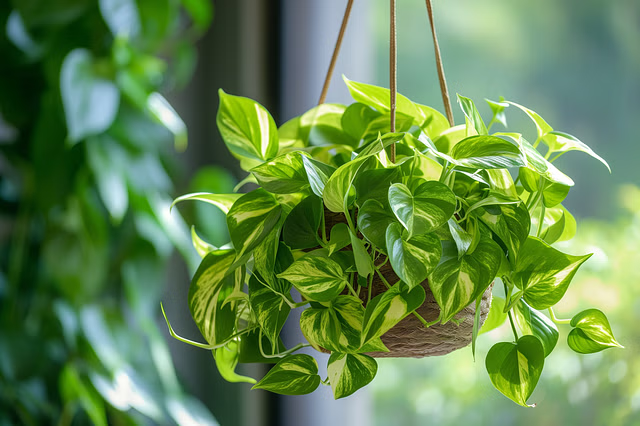
All kinds of indoor plants are poisonous which are harmful to children, old people and pets.But the pathos plant is so healthy in fatal conditions, so how to grow this plant in your home, I have shared in this article.

Scientific classification of pothos plant
- Kingdom: Plantae
- Clade: Tracheophytes.
- Clade: Angiosperms
- Clade: Monocots
- Order: Alismatales
- Family: Araceae
- Subfamily: Pothoideae
- Genus: Pothos
Pothos Plant Prefers


- Light – Bright,indirect light
- Water – Every 1-2 weeks
- Soil – Well draining
- Soil pH – 6.1-6.5
- Temperature – 60-85 degree fahrenhite
- Humidity– 50-70%
- Native area – Australia, New Guinea, Southeast Asia
- Toxicity– Human and pets
How to grow and care Pothos plant
Here, I will explain you about my experience on how to grow your pothos plant.
Light
Direct sunlight can help actually lead to sunburn for pothos plants, causing damage to the leaves and potentially stunting growth. Instead, aim for bright indirect light or filtered sunlight. This plants do best in bright, indirect light. Place your Pothos near a window with a sheer curtain, or in a spot that receives bright but filtered light. Avoid placing the plant in direct sunlight, as this can burn the leaves and cause them to wilt.thrives in bright, indirect light but can also tolerate low light conditions.
Water
Water your Pothos every 1-2 weeks, allowing soil to dry out between waterings. Expect to water more often in brighter light and less often in lower light. Some signs of overwatering include yellowing leaves and black stems, while underwatered plants will wilt and their potting mix will dry out. Pothos is a very forgiving and drought-tolerant plant, but it only has a certain amount of roots in a potted container. This houseplant will likely die after 3 or 4 weeks without getting watered.One of the most common indicators that your pothos has been overwatered is exceptionally wet and soggy soil.
Soil


The best soil for pothos plants should be well-draining and rich in nutrients. By using a mixture of peat moss, perlite, vermiculite, and compost, you can provide your pothos with the perfect growing environment.Approximately two inches of space between the roots and the walls of the pot. If the gap is too wide, the new moist soil will sit for too long before roots can colonize it.Start with a base of standard potting soil.Add perlite for drainage, and coconut fibers or sphagnum moss to retain moisture. This combination creates a soil environment that’s just right for your Pothos – moist but well-draining.
Temperature & humidity
Depending on the conditions in your home, you may need to water your Pothos once or twice a week. They prefer their surroundings not too hot, not too cold. The sweet spot for these leafy beauts lies between 60-85°F.There is no universal temperature for all plants that is too cold, so that is why it is important to do your research.Depending on the conditions in your home, you may need to water your Pothos once or twice a week.
You can increase humidity around the plant by keeping it in a typically humid area of the home. Keeping them in a room with a humidifier or putting a tray of water next to the plant can help keep the humidity levels right.Pothos is very easy to grow, so is an excellent choice for the beginner. It does best in filtered light, with high humidity.
Fertilizer
Pothos (Epipremnum) plants require three primary nutrients to live: nitrogen, potassium, and calcium phosphorus. These macronutrients promote root and leaf growth and help the plant with vital processes such as photosynthesis and water intake. It will benefit from fertilizer with a NPK ratio around 3-1-2, with 3 parts nitrogen, 1 part phosphorus, and 2 parts potassium, or a balanced 2-2-2 ratio. You can choose between granular or liquid fertilizer.
Pruning


If you want to prune you plant then choose to one of the nodes because this is where new growth will emerge as well.The part of the stem in between nodes is known as the internode. Pothos plants are overachievers. These puppies will grow and grow and grow.Remove dead and wilted leaves regularly. If you want to curb the growth of the devil’s ivy a little, you can always reach for the secateurs. The best time to trim your pothos is in spring, after which the plant can grow back healthily. As a rule, prune back the shoots by two thirds.
Pothos Plant Propagation
Pothos plant propagation can be done in water or soil, but once it begins, the plant has difficult switching to the other growing medium. If you place the cutting in water, the plant should remain in water once it grows larger. The same goes for a cutting propagated in the soil. It takes 3-6 weeks for Pothos cuttings to root in water, so patience is required.You can speed up the timeline by placing the propagate in direct sunlight, rooting hormone.
The main advantage of cinnamon for encouraging root growth is that it has antimicrobial properties, which can help keep the plant healthy while new roots are forming. Apply a little cinnamon powder to the cut stem of the plant to encourage root growth.


Common problem of Pothos Plant
- Pothos is usually pest-free, but it can attract spider mites, whitefly, scale, and mealybugs.
- Low-maintenance pothos can experience common houseplant problems, including pests and diseases.
- Yellow leaves is a common disease of every plant. Pothos plants with root rot cannot take up any water or nutrients to keep the plant growing, resulting in the yellowing of the leaves.
Benefits of Pothos plant
- One of the main benefits of the Pothos is its ability to purify the air. It naturally filters out harmful toxins such as formaldehyde, benzene, and xylene, making it a great choice for improving indoor air quality.
- The Golden Pothos, also known as Devil’s Ivy, is considered lucky in Feng Shui. Part of the Money plant family, it is believed that they can bring good fortune, a prosperous future, and stability in life.
- The leaves contain insoluble calcium oxalate crystals that can cause negative reactions due to their needle-like shape. While Pothos can be harmful if ingested, it will not be fatal.