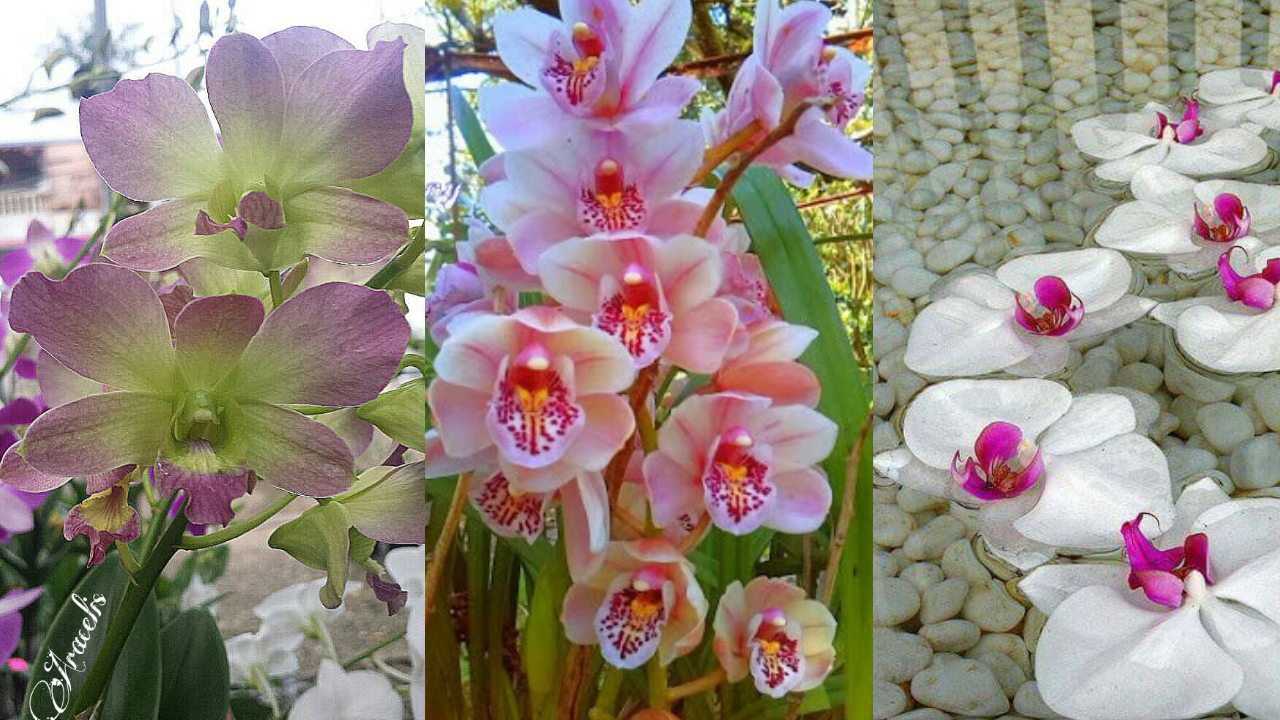
I have shared orchid benefits with you but it has many varieties, today I will share them based on my experience.

Here, I will explain you 15 types of orchid, based on my experience.
15 types of orchids
- Dendrobium orchid
- Encyclia orchid
- Epidendrum orchid
- Laelia orchid
- Catasetum orchid
- Brassia orchid
- Brassavola orchid
- Ascocenda orchid
- Aerangis orchid
- Cattleya orchid
- Ludisia orchid
- Oncidium orchid
- Vanda orchid
- Maxillaria orchid
- Miltonia Orchid
Types of Orchids
1. Dendrobium Orchid


They are known for their vibrant and colourful flowers that bloom in a wide range of shapes, sizes, and colours. Dendrobiums require a specific set of growing conditions to thrive, but with proper care, they can be grown successfully in both indoor and outdoor settings. Dendrobiums should be placed on an east facing windowsill, or a slightly shaded southern one, in a bark mixture.They are very easy to grow, many bloom twice a year, and their flowers often last for months.
2. Encyclia orchid


Encyclia cordigera’s leaves and inflorescence are arching and stately. Even with its thin roots, because of its long dry period alternating with a very wet summer, Encyclia cordigera needs an open, fast-draining, and fast-drying mix. Encyclia orchids, relatives of the other Cattleya alliance orchids, require somewhat similar care.Orchids require enough sunlight to produce flowers, but some require full sun for the whole day while others grow better only in the shade.
3. Epidendrum orchid


Epidendrum radicans is a species of orchid. Common names include ground-rooting epidendrum, fire-star orchid, rainbow orchid, and reed-stem epidendrum. It has thick roots that produce a covering called velamen, which helps absorb water and nutrients above ground or anchor in well-drained soil.Epidendrums are very easy to grow plants and can blooms several times in a year. These plants are amazingly adapted to a variety of conditions and are available in a wide range of colours.
4. Laelia orchid


This plant is also called Perrin’s laelia. It is medium sized , warm growing, epiphytic species that blooms in the late summer through the winter.The Western Underground Orchid is so rare that scientists believe there are fewer than 50 plants in the world. Its habitat is the broom bush scrubland of Western Australia, and it spends its entire life below ground.They are expensive because they are difficult to find. Most endangered species of Orchids are threatened by the destruction of their native habitat in the wild.
5. Catasetum orchid

Catasetum type orchids are a very unique group of orchids. This group contains 4 separate genera Catasetum, Clowesia, Mormodes, and Cycnoches and all their hybrids. Native to Central America to South America they are used to tropical climates with a defined wet-dry season.Catasetum orchids should be fertilized every two weeks during the growing season with a balanced fertilizer.Reduce fertilizing to once a month during the winter months. Temperatures should be reduced to 55 degrees F at night, with day temperatures of 70 to 85 degrees F.
6. Brassia orchid


Brassia caudata, commonly called the Spider Orchid, occurs in Mexico, West Indies, Central and northern South America and Florida. This epiphyte has strongly flattened pseudobulbs with two glossy, relatively long, green leaves that spread out from the apex.Brassia’s flowers are so light and delicate, they move when you walk past. For that reason the orchid is also known as the ‘dancing lady‘ in South America.Water well from the top and leave to drain.Never stand the plant in excess water but make sure that it is allowed to drain away.
7. Brassavola orchid


Lady of the Night is the common name of Brassavola nodosa, an epiphytic orchid native to low-lying coastal regions of Central and Southern America. It is a small, tough species of orchid native to Mexico, Central America, the West Indies, and northern South America. It is also known as Lady of The Night Orchid due to its citrus and gardenia-like fragrance which begins in the early evening. These fast-growing plants can be purchased year-round.
8. Ascocenda orchid


Ascocendas are a more compact version of a Vanda with substantially smaller flowers. It prefer full sun exposure and bright light with warm temperatures and high humidity levels. These orchids are all epiphytic and sympodial in their growth habit. To this end they sport long trailing roots that are capable of drawing nutrients and the required moisture from the atmosphere.The choicest flowers are flat and round, with very bright colors.
9. Aerangis orchid


The Aerangis biloba grows well on wooden mounts as well as in organic media such as bark chips with some moisture retentive sphagnum moss or cocoa chips. This orchid loves a good wet-dry cycle. It does not like to be in a continuously moist environment. Plants should be grown in low light with only slight drying allowed between watering. Can be grown mounted or potted using a fine seedling grade bark.
10. Cattleya orchid


A Cattleya with dark green leaves will not bloom, but one with light green leaves is getting enough sun to bloom well. Cattleyas, however, should not get direct mid-day sun or they will sunburn. Red-tinged leaves are a sign of too much sun.If you’ve never grown a Cattleya before, however, there are some things to know about them. Namely, they love indirect light and don’t need frequent waterings. They are complex fragrances that range from citrus to beautiful floral. Oncidiums have fragrances that make you hungry,they range from chocolate and vanilla to tropical punch.
11. Ludisia orchid


These orchids need moist compost, but let the top third of the compost dry out between waterings. Feed with orchid fertiliser every two to four weeks during the growing season. Ludisia orchid flowers are small and relatively unshowy compared to epiphytic orchids. White, trumpet-shaped flowers with yellow centers and a pink calyx grow along a green flower spike that grows from the crown of the plant. The flowers emit a mild, sweet fragrance but aren’t particularly known for their aroma.
12. Oncidium orchid


Oncidiums are light-loving orchids, with some able to handle direct, full sun. They thrive at 60-65° F at night, and 70-85° F during the day. If you have a Oncidium orchid growing indoors on a windowsill and it has not bloomed in a year or two, chances are a lack of sufficient light is the reason.Oncidium pseudo-bulbs take about 8-9 months to fully mature and produce blooms. This is the rule, but of course there are exceptions.
13. Vanda orchid


Originating in tropical Asia, they are easily grown in warm climates, where plants are cultivated outside in light shade, such as in a lath house. In climates where winters are cold, they are often summered outside, and grown inside during the winter in a sunny window, or year round in a greenhouse.Vandas require bright light, but they generally don’t thrive in full sunlight. They can acclimate to full sun, though plants grown in those conditions are generally washed out and not as healthy as those grown under a shade cloth to take the edge off strong sunlight.
14. Maxillaria orchid


These orchids flower once a yearfor about 7 to 10 days during the early spring. If your plant does not flower, it’s likely because it is not getting enough light.Make sure the plant is adequately fed and watered (not too much, not too little) and receiving enough sunlight. The Maxillaria orchid is an easy to grow orchid that smells like fresh coconuts. Care is simple – keep it moist & high light like Cattleya. It can take a wide range of light and will take bright light up to about 5000 foot candles.
15. Miltonia orchid

%3Amax_bytes(150000)%3Astrip_icc()%2Fmiltonia-orchid-care-guide-5221547-01-f2aa03aa5d8c4d45aa229a29757b8683.jpg&tbnid=Kwtu4PGX6M5dsM&vet=1&imgrefurl=https%3A%2F%2Fwww.thespruce.com%2Fmiltonia-orchid-care-guide-5221547&docid=5GEZrIppOw9NqM&w=1500&h=998&source=sh%2Fx%2Fim%2Fm4%2F2&kgs=0f233d76093b528f&shem=abme%2Ctrie#vhid=Kwtu4PGX6M5dsM&vssid=mosaic)
The miltonias are exclusively inhabitants of Brazil, except for one species whose range extends from Brazil into the northeast of Argentina and the east of Paraguay. Unusual to orchids, about 80% of our Miltonia varieties are fragrant, with a scent similar to a rose’s. Our “Pink Lemonade” variety is strongly fragranced, while our white has the lightest fragrance.Temperature is critical for the cool-growing plants. Unless temperatures are kept under 80 F, they may not flower. The minimum temperature is 50 to 55 F.