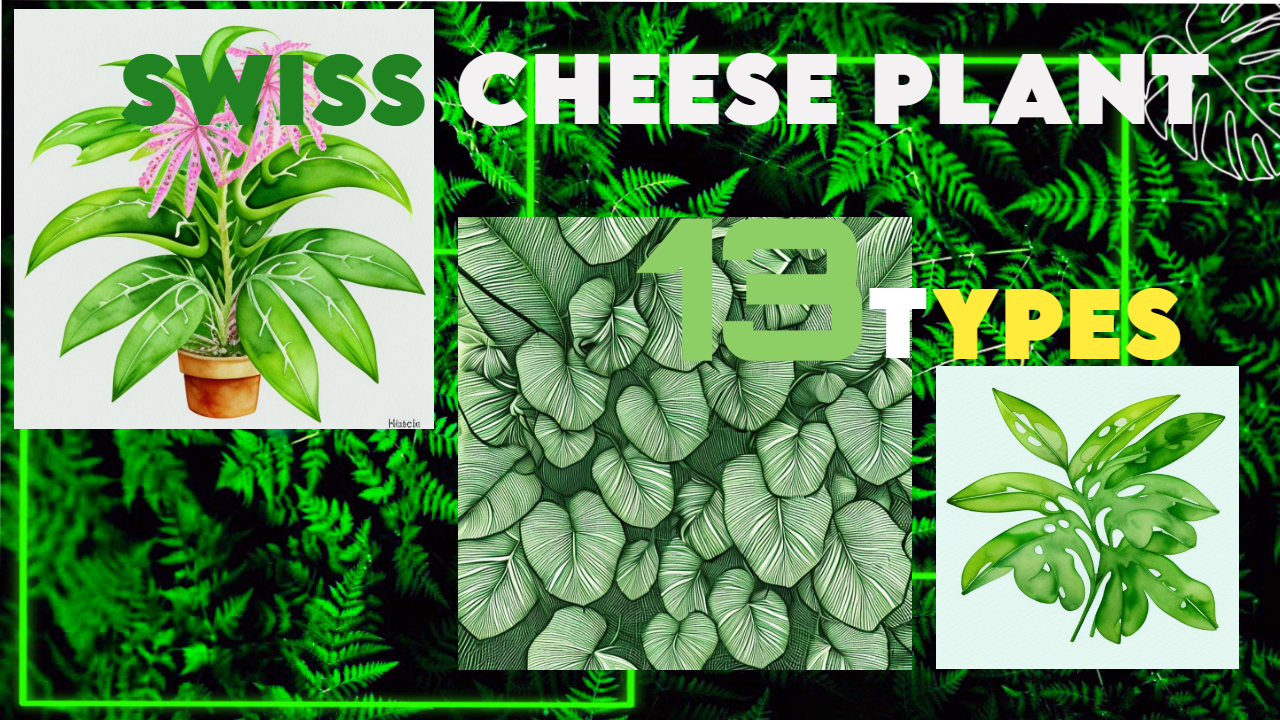
One type of money plant variety is the Swiss Chase plant. Let me tell you about the variety again, so let’s start.

Here, I will share you 13 types of swiss cheese plant.
13 types of Swiss cheese plant
- Matuda Monstera
- Mini Monstera
- Monstera borsigiana
- Monstera esquelet
- Monstera peru
- Shingle plant
- Monstera oblique
- Monstera Dubia
- Monstera acacoyaguensis
- Monstera variegate
- Monstera adansonii
- Monstera siltepecana
- Monstera pinnatipartita
Swiss Cheese Plant Types
1. Matuda Monstera

A Swiss cheese plant is typically 30-40 years with proper care. However, there are several factors that can affect the longevity of a Swiss cheese plant, including environmental conditions, nutrient deficiencies, pest infestations, and improper watering. The plant doesn’t like having its roots bound by a small pot, so too does tightly packed soil annoy the heck out of it.
2. Mini Monstera


The Rare Mini Monstera is not commonly found everywhere. The rarity of these variegated Monstera plants is due to the fact of how challenging it is to grow. Usually the more rare something is, the more people want it. These plants can grow pretty quickly so be prepared to do some occasional repotting, the ideal time to re-pot is early Spring when the plant had a period of active growth ahead.
3. Monstera borsigiana


The best way to identify borsigiana is to check the top of the mature leaves. Where the stem meets the leaf, the true Deliciosa will have a wrinkle that the Borsigiana does not. It is considered the most rare of the variegated Monstera varieties and people have paid thousands of dollars for this houseplant.The rarity of these variegated Monstera plants is due to the fact of how challenging it is to grow.
4. Monstera esqueleto


Monstera esqueleto may have difficulty thriving, and will drop leaves , without ample sunlight. Place it less than 3 feet from a south-facing window to maximize the potential for growth. It is usually treated as a floor plant. Keep it growing and looking its best by giving it a support such as a wall, moss pole or totem on which to climb. Allowing it to grow vertically results in the largest leaves and the fullest plant.
5. Monstera Peru


Monstera Peru is an epiphyte that has an upward, vining growth habit and uniquely puckered thick dark green foliage. Monstera Peru is a slow-growing, low-maintenance plant, requiring less light and water than other species in the monstera genus. It is fast-growing plant with thick, stiff leaves and dark green textured foliage. They are climbers so you can attach them to a totem or trellis.
6. Shingle plant


Grow shingle plant in a medium to bright indirect light. This means a spot where it casts a moderate to strong shadow throughout the day. Avoid direct afternoon sun, particularly in hot-summer climates. It is a rare, beautiful tropical shingling houseplant that has seen a surge in popularity. This plant is easy to care for and can be trained to climb walls or trellises.
7. Monstera oblique


This plant is also known as the “Swiss Cheese Vine” due to the unique holes in its leaves. Caring for the Monstera Obliqua requires some attention to detail, but it’s worth the effort.The high price of the Large Monstera Obliqua is a reflection of these factors: its rarity, the difficulty of propagation and care, and the demand for this unique and aesthetically striking plant. Not only is this tropical plant expensive, but it’s also slow-growing and demanding in its care.
8. Monstera Dubia


Monstera dubia is a rare, lesser-known variety of Monstera. It has gorgeous variegation and a unique growth habit which make it a great addition to every houseplant collection. Monstera dubias require support in order to thrive. It is best to use a flat plank of wood. This is a relatively expensive plant due to its rarity. The price highly varies based on the size and variegation pattern.
9. Monstera acacoyaguensis


Monstera acacoyaguensis isn’t the rarest monstera species available commercially, it is much harder to come by than the popular Monstera deliciosa. Monstera acacoyaguensis is a flowering plant in the family Aracae and the genus Monstera . Its native range is Mexico (Chiapas) to Belize. Although it may be expensive, the plant is worth the investment due to its stunning looks and ease of care.
10. Monstera variegate


Monstera can be forced to variegate using a few different methods, though chemical mutagens or radiation doesn’t guarantee variegation and can cause a whole set of other issues that can damage or kill the plant. All monstera species and their parts are toxic to dogs, cats, and humans. While it has edible fruit, the unripe fruit is still toxic. The main toxic agent present in the plant is needle-like, insoluble calcium oxalate crystals.
11. Monstera adansonii


The Monstera Adansonii, also known as the Swiss Cheese Plant for its holes, is a vining plant perfect for both indoors and outdoors. They are very unique for its hole formations. Monstera Adansonii’s will do best in bright and medium indirect sunlight – a room with a window will do just fine. Monstera Adansonii can not handle direct sunlight, and the leaves will turn yellow, letting you know if they got too much sun. It’s important to provide adequate light, water, and humidity.
12. Monstera siltepecana


Monstera Siltepecana is a popular houseplant thanks to it being easy care and having attractive foliage. Endemic to Mexico and Central America, it’s renowned for the silver markings on its immature foliage.This fast-growing vine is easy to grow in a pot or hanging basket or allow it to climb up a trellis or moss pole. If allowed to climb, the leaves grow larger and may develop the characteristic holes, or fenestrations, that are a trait of most plants in the monstera genus.
13. Monstera pinnatipartita


Monstera pinnatipartita is a unique and lesser-known species of the Monstera plant family. It is native to Central and South America and is known for its striking, deeply dissected leaves. Keep soil evenly moist in a pot with good drainage. It is a rare variety of Monstera, loved for its shiny, textured foliage. Native to the tropics of South America, this plant thrives when it latches its aerial roots and climbs vertically.
I hope you guys like this little presentation of mine. As such I share my garden experience with you as much as I can. If I have omitted anything in this article, please comment.