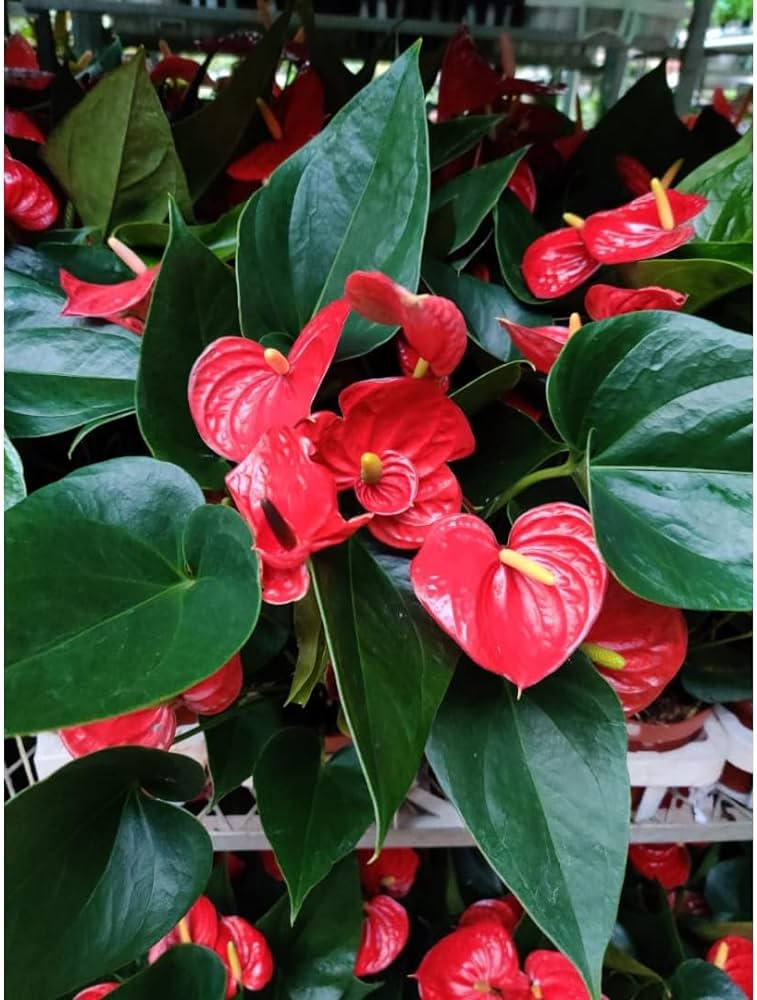
The soil of Anthurium plants should be kept 50 percent wet and should be applied as food with high nitrogen fertilizer during hot and spring. Expand your tropical plant collection with the beautiful blooms of anthurium, it’s also known as flamingo flowers for their unique tropical shape and bright red , green and white. This tropical plant lives about 5 years indoor with proper care but by propagating your plant, you can have a healthy Anthuriums difinitely.
Kingdom – Plantae
Clade – Tracheophytes
Clade – Angiosperms
Clade – Monocots
Order – Alismatales
Family – Araceae
Subfamily – Pothoideae
Tribe – Anthurieae
Genus – Anthurium schott
Prefers


Light – Partial
Soil type – Well drained
Soil pH – Acidic
Temperature – 75° – 85° fahrenheit
Humidity – 65 to 85%
Bloom time – Spring & Summer
Flower colour – Red , Pink
Fertilizer – Liquid
Native area – Central & South America
How to Care Anthurium
Here, I will explain how to care for your plant. If you have brought home a new Anthurium plant, then this article will help you a lot.
Light
It requires bright but indirect sunlight to grow and thrive. Direct sunlight can scorch the leaves,while too little light will cause poor growth and a lack of flowers . A good rule of thumb is to place your anthurium in a spot where it receives bright, filtered light atleast six hours per day. It can handle lower light, but the leaves may not grow as quickly and as large and the plant may not bloom if it does not receive enough light.
Water
It will do best when the soil has chance to dry out in between waterings. Too much or too frequent watering can lead to root rot, which could severely affect the long term health of your plant. For best result, water your plant with just six icecubes or a half cup of water once a week. You can lightly most it’s leaves daily but avoid water drops on the flowers. You can mist also aerial roots when they are there.


If you are looking for an orchid that you can easily grow and enjoy at home. The moth orchid plant is bright and indirect light becomes bigger and more intense direct lights damages this plant.These plants thrive in strong light, but direct sunlight can burn orchids. Bright, indirect light from an Eastern or Southern window is ideal.These beautiful flowers do not need much water and prefer their growing medium to have the opportunity to dry out completely between waterings, which can take about a week or so.Moth orchid like consistently warm condition all year round 19 – 30°C during the day and 16-19°C at night.It can be vegetatively propagated by cutting the flowering stem above a stem inter node, the dormant growth eye is covered with a triangular sheath. Readmore
Soil
Soil mix Anthurium plants prefers a soil mix that’s well draining and rich in organic matter. A mix of peat moss, perlite and coarse sand or bark is ideal for the plants. The soil should be loose and airy to allow for proper root growth and water drainage. A growing media containing 1:1 mixture of leaf mould and coco peat with a pH of 5.5 to 6.5 is ideal, which ensure good drainage as well as water holding capacity.
Temperature & humidity
It will do best with warm temperatures of 75° to 85° fahrenheit during the daytime and 70° to 75° fahrenheit bar night, but temperatures as low as 45° fahrenheit and high as 90° fahrenheit can be tolerated. Anthurium will not survive outside in nontropical zones during the winter. If your plant lives outside for the winter, bring it in as soon as the temperatures drops belt 60° fahrenheit.
This is an important factor for growing Anthurium 65-85% humidity is ideal for quality and production of flowers. In shade houses fogging system would be ideal. Increase humidity around your plant by placing the potted plant on a tray of moistened pebbles or atleast misting the leaves frequently with lime free water.
Fertilizer
During the growing season feed your plant once a month using a complete, 1/4 strength liquid fertilizer. Too much fertilizer can do more harm than good. You can also top dress the soil with organic compost like worm casting. Fertilise anthurium fortnightly with scotts osmocote orchid pour + feed to encourage greater growth.
We are going to take you about 15 incredible uses and benefits of fiddle leaf fig plants at home.There are many benefits to having a fiddle leaf in your home. They are beautiful, they increase humidity, and they can improve your mood and happiness overall.It can be finicky at times, but they can easily thrive with proper condition and care.Another propagation method popular for its putting a cutting or single leaf in water.It is believed that with the proper Feng shui placement of a plant , the plant’s broad, green leaves will cleanse the air by neutralizing negetive energy and allowing more positive energy to flow through the room thereby increasing chances for good luck and prosperity.Fiddlers generally need around 6-8 hours of sunlight a day, but they can hope with less and tolerate more if they are looked after well. Readmore
How To Propagate Anthurium: Detailed Guide


This plants can be propagate from root division too. Anthurium are one of the few plants that are able to be propagated this way, it is a favourite of many anthurium parents because of how simple it is to do and the success brate is much higher than other ways of propagating.
With Anthurium plants, this can get rather tedious as you wait 6 weeks or move to see any root growth, but some people will always choose to propagate in water because it typically has the best outcome. With in 6-8 weeks, you should see new roots growing from the stem.
1. Cut a 6-8 inch section of stem from healthy leafy part of the plant, making sure to make a clean cut at a 45° angle. Do not saw the stem, this cause too much damage and will prevent proper propagation.
2. Dip the cut end of the stem in rooting hormone.
Common problem of Anthurium
Overwatering
It can cause the leaves to fall off completely if the problem is not fixed quickly. It can also lead to root rot, which can kill the plant. To avoid overwatering, water only when the soil is dry to the touch.
Underwatering
Droopy leaves with browning leaf tips and shrivelling aerial roots are signs of an under watered plant. Anthurium loves a humid environment, so you can mist everyday. Try to use a pebble tray or a humidifier during the dry winter months.
Pests


Aphids, these insects suck the plant’s sap cause yellowing and distortion of leaves and poor growth. Systemic insecticides containing dimethoate and Malathin effectively control the aphids.
Sunburn
Too much direct sunlight can scorch the leaves resulting in the tips and edges of Anthurium leaves browning. This plant can fall victim to intense sun exposure if placed too close to a South facing window.
Low temperature & humidity
It requires porous, well drained aerated soil rich in organic matter content. The soil pH should be 5.5-6.5. It performs well under green shade net having 70-80% shade intention with 80-90% humidity and 24-28°C temperature and 15-22°C night temperature with 1500 – 2000 foot candles light intensity.
Falling to repot
Pot bound Anthuriums require adequate space for root growth. If the plant has out grown it’s pot, it may drop leaves. Repot the plant into a larger pot to provide more space for growth. Disease such as fungal infection or bacterial infection can cause Anthurium leaves to wilt and drop.
[…] The soil of Anthurium plants should be kept 50 percent wet and should be applied as food with high nitrogen fertilizer during hot and spring.It requires bright but indirect sunlight to grow and thrive. Direct sunlight can scorch the leaves,while too little light will cause poor growth and a lack of flowers .It will do best when the soil has chance to dry out in between waterings. Too much or too frequent watering can lead to root rot, which could severely affect the long term health of your plant.Soil mix Anthurium plants prefers a soil mix that’s well draining and rich in organic matter.It will do best with warm temperatures of 75° to 85° fahrenheit during the daytime and 70° to 75° fahrenheit bar night. Read more […]
[…] The soil of Anthurium plants should be kept 50 percent wet and should be applied as food with high nitrogen fertilizer during hot and spring.It requires bright but indirect sunlight to grow and thrive. Direct sunlight can scorch the leaves,while too little light will cause poor growth and a lack of flowers .It will do best when the soil has chance to dry out in between waterings. Too much or too frequent watering can lead to root rot, which could severely affect the long term health of your plant.Soil mix Anthurium plants prefers a soil mix that’s well draining and rich in organic matter.It will do best with warm temperatures of 75° to 85° fahrenheit during the daytime and 70° to 75° fahrenheit bar night. Read more […]
Your blog post on how to care for Anthuriums is incredibly informative and helpful! Anthuriums are such beautiful and unique plants, and your detailed guide covers all the essentials for ensuring their health and vitality. I appreciate how you broke down the care instructions into easy-to-follow steps, from watering and light requirements to soil type and fertilization. Your emphasis on providing proper humidity levels and avoiding common mistakes like overwatering or placing the plant in direct sunlight is invaluable for Anthurium enthusiasts like me.